Restorative Discipline: When Practice Doesn’t Match the Promise
Discipline in Our Schools
Enter almost any school today, and you'll encounter language centered on progress, inclusion, equity, and belonging. Such words fill hallways, mission statements and professional development slides, signaling commitment to the improvement and transformation of our education systems. Beneath the posters and promises of ideals and aspirations, an adverse truth persists. For too many students, when it comes to discipline, the systems intended to support them still reproduce the same inequities that school values claim to oppose. There is a gap between what we say we value and what students actually experience, which exposes not a lack of intention, but insufficient implementation.
For decades, discipline systems have relied heavily on exclusionary practices such as suspensions, expulsions, and classroom removals as the default response to student (mis)behavior. Extensive research, advocacy, and lived experience have made clear: punitive discipline doesn’t teach, it doesn’t repair, and it doesn’t build accountability. Instead, it erodes trust, widens opportunity gaps, and disproportionately harms students of color, students with disabilities, and those already navigating systemic inequities.
Across the nation, Black, Brown, Indigenous, and disabled students continue to be suspended, expelled, or referred for discipline at disproportionately higher rates than their peers often for the same behaviors (ACLU SoCal, 2016; ACLU, 2020). Behind these numbers are young people who have lost not only days or weeks of instruction, but also something far more significant: their trust in school as a place of safety and belonging.
Every time a student is removed from class, a message is sent about who is worthy of support, who is granted grace, and who is viewed as a problem to be removed. Over time, these messages shape how students see themselves and how they believe others see them.
At Collaborative Learning Solutions, we believe that how schools respond to behavior is not just an operational concern, it’s a moral and educational imperative. Equity, opportunity, and justice must guide every decision we make about discipline. To create schools where all learners can thrive, we must confront the structural harms embedded in traditional models and commit to approaches that are supportive, restorative, and grounded in belonging.
As educators and leaders, we carry both the responsibility and the opportunity to reimagine what discipline can be, to build systems that heal rather than harm, that teach rather than punish, and that ensure every child is seen as inherently deserving, capable, and worthy of care.

When Restoration Is Added to a Broken System
In response to decades of research and advocacy exposing the harms of punitive policies disproportionately impacting Black, Brown, Indigenous students, students with disabilities, and other marginalized demographics many schools have turned toward restorative practices. These are hopeful developments and too often, they exist as fragmented efforts rather than systemic change.
At their best, restorative approaches shift schools away from punishment and toward accountability, relationship-building, and repairing harm. When implemented with fidelity, restorative practices strengthen school climate, improve relationships between students and teachers, and reduce suspensions and discipline referrals.
But there is a critical challenge emerging in the research: restorative practices do not automatically eliminate inequities in school discipline.
A growing body of evidence suggests that while restorative approaches can reduce overall suspension rates, disparities between student groups can still persist. A large study examining restorative justice implementation in schools found that although disciplinary outcomes improved overall, racial disproportionality in discipline did not disappear and in some contexts remained largely unchanged. (Davison et al., 2022)
This raises an important question for educators and district leaders: Who is actually receiving restorative responses and who is not?
In many schools, restorative practices are implemented inconsistently. Students who are perceived as cooperative, engaged, or “reachable” may be offered restorative conversations or circles. Meanwhile, students who are labeled as defiant, disengaged, or challenging, often disproportionately students of color, students with disabilities, or students already marginalized by school systems, still experience exclusionary discipline.
This contradiction undermines the very purpose of restorative practices. The students most frequently excluded from restorative responses are often the students who would benefit from them the most. Young people navigating the impacts of racism, poverty, community violence, or gang involvement are far more likely to carry experiences of trauma, instability, and mistrust of institutions. These experiences can show up in school as anger, disengagement, or conflict with adults and peers. Restorative practices are intended precisely for situations like these, to replace punishment, repair harm, rebuild trust, and create opportunities for accountability and belonging.
Yet in many schools, the opposite occurs. Restorative approaches are offered to students who are already relatively compliant and connected to school, while students whose behavior challenges adults the most are quickly removed, suspended, or punished. In effect, the students who are easiest to work with receive restorative responses, while the students whose experiences and circumstances make connection most necessary are pushed further out of the community.
If schools are serious about restorative approaches, they must apply them where they matter most, with the students who have experienced the deepest marginalization and the greatest harm. Restorative practices are not meant to be a reward for compliance. When the students most affected by racism, poverty, and systemic exclusion are the ones most likely to be removed instead of restored, the promise of restorative practices is not being fulfilled.
This does not mean restorative practices are ineffective or a lost cause. In fact, research consistently shows that punitive exclusionary discipline can worsen student outcomes, harm school climate, and contribute to long-term disengagement from school as well as the school-to-prison pipeline. The issue is not the philosophy of restorative practices, it is how they are implemented.
Restorative practices are often layered onto a fundamentally inequitable structure rather than transforming the structure itself. When restorative practices are treated as optional "add-ons" rather than a fundamental redefinition of district-wide accountability, they risk being layered onto the very inequitable structures they aim to transform.
Without clear policies and consistent discipline frameworks to guide adult decision-making, implementation becomes uneven and subject to individual bias or comfort levels. This lack of procedural safeguards allows subjective judgment to seep back into the system, determining who is seen as "restorable" and who is punished for the same behavior. To truly advance equity, restorative approaches must be embedded within shared expectations; otherwise, they may inadvertently reproduce the same systemic inequities under the guise of new language.
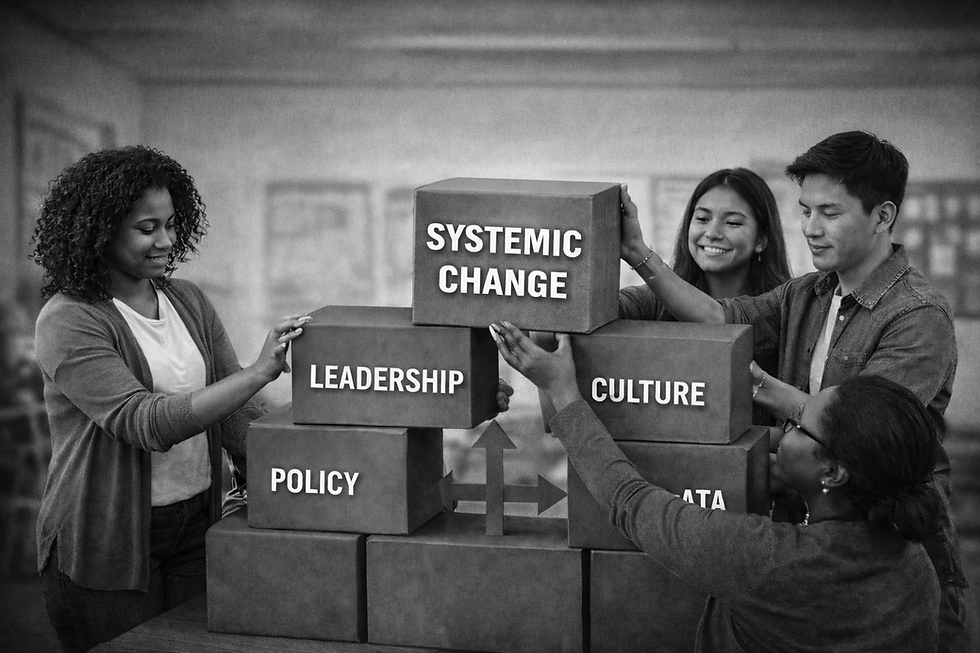
This is the central challenge districts now face: in adding restoration to a system designed for exclusion, instead of redesigning the system. True fairness cannot hinge on who is in the office that day, it must be built into the architecture of policy, training, and culture. That means moving beyond isolated pockets of good intention and committing to districtwide alignment where every school, every educator, and every student is guided by a shared framework of care, accountability, and belonging.
Systemic Implementation
Restorative Practices implementation requires a fundamental reexamination of deeply held beliefs about control, compliance, and consequences. It demands recognizing that true restoration cannot thrive in isolation; restorative work must be intentionally embedded into policies, procedures, and daily school practice with fidelity. When implemented districtwide, restorative frameworks not only promote equity and consistency for all students, but they also reduce disparities in discipline, build trust, and reinforce legal and ethical safeguards by protecting students’ rights and reducing liability for schools. These frameworks reshape school culture into one grounded in care and accountability, where responses to harm are relational rather than reactionary. Restorative practices strengthen complementary initiatives like MTSS, SEL, and PBIS by addressing the root causes of behavior through social-emotional and relational skill-building.
This work is not easy. It requires mindset shifts, sustained training, and leadership that models restorative values in every decision. It requires time to listen, reflect, rebuild, and courage to move beyond the illusion of control that punitive systems offer. But the alternative is clear: without structural transformation, districts risk repackaging inequity.
Restorative discipline offers not just a new approach, but a new foundation. One where accountability is shared, fairness is designed, and every student is given the chance to learn, repair, and belong.
A Moral and Legal Imperative
But to realize this potential, we must first confront the reality of our current systems. Disproportionate discipline isn’t just a procedural flaw, it’s a moral failure. Every exclusionary decision sends a message about who belongs and who doesn’t.
When restorative responses remain optional or inconsistently applied, schools recreate the very inequities they claim to address. Districts have both the moral and legal imperative to redesign their discipline systems around compassion, consistency, and fairness.
A Call to Transform Systems
Restorative practices were never meant to sit on top of punitive discipline like seasoning on bad food. They are a fundamentally different way of addressing harm, rooted in pre-colonial traditions that center belonging, accountability, and collective safety. Transforming discipline is about identifying root causes and addressing them. It’s about leading with the conviction that every student, regardless of background or behavior, is worthy of dignity, accountability, and belonging.
That belief, when backed by policy and consistent practice, turns equity from an aspiration into a goal, and schools into the caring communities they claim to be.
Part two of this blog series will explore common implementation missteps and provide tangible remedies.
Our experienced consultants can support the needs of your schools and districts through
professional development training workshops, coaching sessions, and ongoing systems support. Contact Us to request a free consultation.
References
American Civil Liberties Union (ACLU). (2019, March 4). Cops and no counselors: How the lack of school mental health staff is harming students. https://www.aclu.org/publications/cops-and-no-counselors
American Civil Liberties Union (ACLU). (2020, July 7). Police in schools continue to target Black, Brown and Indigenous students with disabilities — The Trump administration has data that’s likely to prove it. https://www.aclu.org/news/racial-justice/why-school-discipline-reform-still-matters
American Civil Liberties Union of Northern California (ACLUNC). (2016). Discipline in California: Policies and practices that push students out of school and into the justice system. https://www.aclunc.org/sites/default/files/discipline_in_california.pdf
American Civil Liberties Union of Southern California (ACLU SoCal). (2021, August 24). No police in schools: A policy agenda to keep California students safe. https://www.aclusocal.org/sites/default/files/field_documents/no_police_in_schools_-_report_-_aclu_-_082421.pdf
American Civil Liberties Union of Southern California (ACLU SoCal). (n.d.). Appendix C: ACLU board policy on police in schools. https://www.aclusocal.org/sites/default/files/appendix-c-aclu-board-policy.pdf
American Civil Liberties Union of Southern California (ACLU SoCal). (2016). The right to remain a student: How California school policies fail to protect and serve. https://www.aclunc.org/sites/default/files/20161019-the_right_to_remain_a_student-aclu_california_0.pdf
Davison, M. L., Penner, A. M., & Kreitzer, R. J. (2022). Racial/ethnic disparities in school discipline: A systematic review of the literature. Frontiers in Psychology, 13, 956299. https://doi.org/10.3389/fpsyg.2022.956299